

Under-eye bags, malar swelling and festoons: what is the difference?
Compare under-eye bags, malar oedema, festoons and hollows: assessment, treatment limits, evidence and urgent warning signs.
Consultation information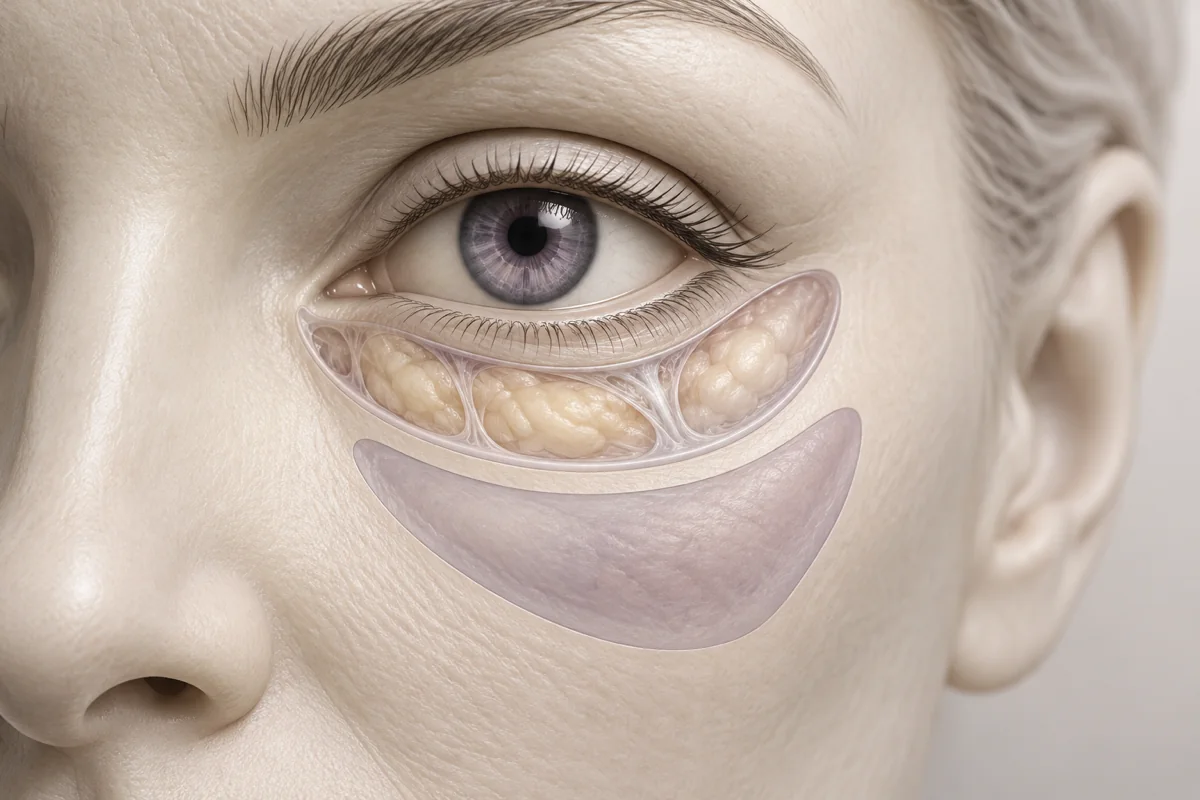
On this page
Are all bulges below the eye the same?
No. A lower-lid fat bulge, swelling over the upper cheek and a fold of lax tissue can look similar in a photograph but require different decisions. The terms malar mound and festoon are not used identically in every publication. Explain where the concern is and how it changes rather than relying on a label alone. M1 M2
What should an assessment establish?
The assessment should establish the cause before selecting a treatment. Describe onset, variation, pain, itching, visual symptoms, health conditions and previous surgery or injections, including older fillers. Examination considers eyelid position, closure, eye surface and the location and consistency of the swelling. Imaging or other tests are chosen when indicated; a photograph cannot replace the examination. M1 M3
How do the main findings compare?
| Finding | Main feature | Usual area | Assessment focus | Treatment limit |
|---|---|---|---|---|
| Lower-lid bag | Prominent orbital fat may contribute | Lower eyelid | Fat, skin and lid support | Lower-lid surgery does not automatically resolve cheek swelling. R1 M1 |
| Malar oedema | Fluid-related swelling | Upper cheek below the lid | Variation, triggers and medical or treatment history | Adding volume does not establish or treat the cause. M1 M3 |
| Festoon or malar mound | Persistent fullness or lax tissue fold | Lid-cheek transition | Tissue laxity, swelling and terminology used | One technique is not suitable for every presentation. M1 M2 |
| Tear-trough hollow | Depression with a shadow | Junction of lid and cheek | Hollowing versus adjacent swelling | A hollow is not the same as a bag; problems can coexist. M1 M3 |
The table is a vocabulary guide, not a self-diagnosis tool. A mixed pattern may need a staged plan, and correcting one feature may leave another visible. The examination should identify what each proposed step is expected to change. M1 M2
What options may be discussed?
Options depend on the finding and may include observation, addressing an underlying cause, or a tailored procedure. Lower-lid surgery, selected skin treatments and festoon-specific approaches have different aims and risks. Previous hyaluronic-acid filler may need assessment when swelling recurs. Do not assume that another injection or dissolving treatment is the solution, or that treatment is required at all. M1 M2 M3
When should cosmetic treatment be deferred?
Unexplained new swelling, a red or painful eye, visual symptoms or suspected infection should be assessed first. Active inflammation or infection can make filler treatment inappropriate until managed. Tell the clinician about medicines, allergies and prior procedures. A stable cosmetic concern can be discussed electively; a newly changing eye problem should not be booked as a routine appearance consultation. M4 F1
What risks and limitations matter?
Risks vary by intervention. Surgery can involve scarring, asymmetry, persistent swelling, lid position problems, bleeding or infection; further treatment may be necessary. Fillers can cause swelling and nodules and, rarely, serious vascular injury affecting skin or sight. A published treatment method is not proof of suitability, local authorisation, availability at this clinic or a guaranteed result. R1 M2 F1
How strong is the treatment evidence?
Evidence does not support a universal promise. One published surgical series was retrospective, while a report on recurrent swelling after hyaluronic-acid filler included only five patients and combined treatments. Such reports can inform discussion but cannot prove which treatment is best for everyone. Ask about uncertainty, recurrence, recovery, alternatives and what further treatment might involve. M2 M3
Frequently asked questions
Will blepharoplasty always remove festoons?
No. The target structures differ, and a plan for lower-lid fat cannot be assumed to correct a cheek fold or fluid swelling. R1 M1
Does morning swelling prove that I have festoons?
No. Variation is useful history, but fluid swelling has several possible causes. Diagnosis needs a clinical assessment. M1
Can filler hide every under-eye problem?
No. More volume may be inappropriate when swelling is present. Earlier filler, skin changes and other findings need assessment before further treatment. M3 F1
Is dissolving filler a home treatment?
No. Assessment and any removal plan belong with a qualified clinician; removal has risks and some materials are difficult or impossible to remove. F1
Can a study's result be promised to me?
No. Small or observational studies do not predict an individual's outcome. A consultation should explain limits and alternatives, including no procedure. M2 M3
Sources
- R1: NHS — Eyelid surgery
- R4: NHS — Eye pain
- M1: American Academy of Ophthalmology EyeWiki — Festoons
- M2: Asaadi et al. — Outcomes of Surgical Treatment of Malar Mounds and Festoons
- M3: Karlin et al. — Post-Hyaluronic Acid Recurrent Eyelid Edema
- M4: NHS — Eyelid problems
- F1: FDA — Dermal Fillers (Soft Tissue Fillers)