

Heaviness above the eyes: brow or eyelid?
Heaviness above the eyes may relate to brow position, excess upper-eyelid skin or a low eyelid margin; these can coexist.
Consultation information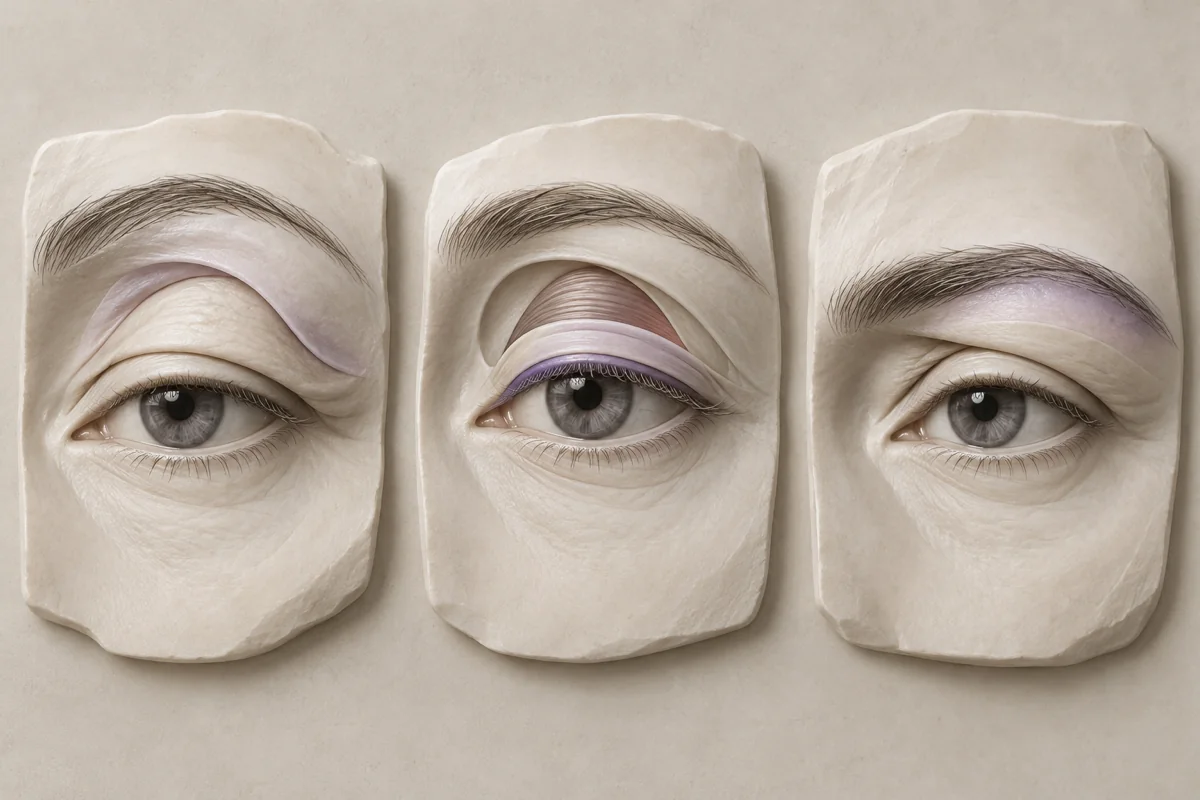
On this page
How are the possible causes distinguished?
Looking only at an overhanging skin fold is insufficient. Brow position, lid margin and movement are considered separately, with a visual-field test when appropriate. Explain when heaviness began and how it affects everyday function. B1P1
| Possible contributor | Key distinction | Examination focus | Option to discuss | Limitation |
|---|---|---|---|---|
| Excess skin | A skin fold overhangs | Distribution of excess tissue | Blepharoplasty assessment | Different from a lifting problem B1 |
| Brow descent | Brow position contributes | Brow–eyelid relationship | Brow-directed options | Skin removal alone may be insufficient B1 |
| Eyelid ptosis | The lid margin sits low | Lifting function and cause | Cause-appropriate ptosis approach | Cannot be confirmed by a photograph P1 |
This table is not a self-diagnostic test. Several contributors may require combined or staged consideration; that is not an automatic recommendation for combined surgery. B1P1
Which treatments address different targets?
Blepharoplasty addresses excess tissue, ptosis procedures address lifting problems, and brow procedures address brow position. Function, expectations and examination determine which target matters. B1P1
A change in appearance may not relieve every sensation of heaviness or dryness. Surface disease may need separate attention first; perfect symmetry and permanently youthful appearance cannot be promised. B1D1
What should you bring to assessment?
Share your medicines, previous operations, eye conditions and symptom timeline. Older photographs can help. Do not make independent decisions to stop prescribed treatment. P1C2
What are the risks of intervention?
Discuss bleeding, infection, asymmetry, undercorrection, overcorrection and possible further procedures. Closure and dryness matter; preserving eye function takes priority over appearance measurements alone. B1P1
Which functions are checked afterwards?
Review considers closure, the eye surface, vision and everyday comfort as well as lid height. Recovery varies, and an early photograph alone should not determine another operation. B1P1
What are the common questions?
Does improvement when I lift my brow prove the cause?
No. Manually lifting the brow may change the appearance but does not establish the cause or the required operation. It is not a substitute for examination. B1
Are excess skin and ptosis the same?
No. Excess skin concerns overlying tissue; ptosis concerns lid-margin position. They may occur together in the same person. P1
Can one operation correct everything?
Not always. When several structures contribute, each target should be explained. Treating everything in one session is not established as better for everyone. B1P1
Does dryness affect planning?
Yes. Surface and closure assessment can change the options. Dryness is not simply a problem solved by removing more skin. P1D1
Can observation be an option?
Depending on findings and preferences, observation or no procedure can be discussed. A functional problem or new symptom first requires clarification of the cause. B1C1