









Ultrasound-guided filler dissolution: what can it clarify?
Ultrasound may help assess location and plan targeted intervention in selected filler problems.
Consultation information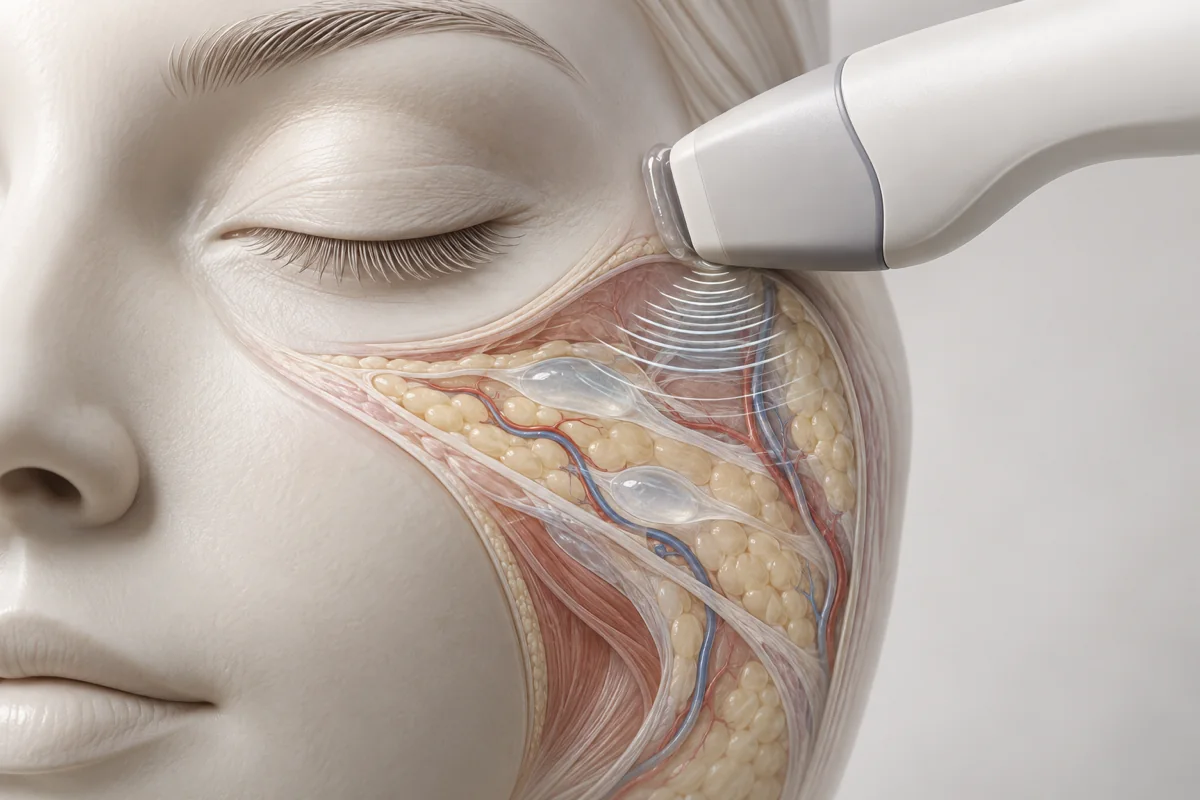
On this page
Which questions can ultrasound help answer?
First clarify symptom onset, previous injections and current findings. Ultrasound can add information in selected cases; not every swelling or irregularity can be attributed solely to remaining filler. U1F1
| Situation | Assessment aim | Possible tool | Decision question | Limitation |
|---|---|---|---|---|
| Location question | Assess where material lies | Ultrasound and examination | Is a targeted approach appropriate? | Operator and interpretation matter U1 |
| HA-related irregularity | Relate material to symptoms | History and examination | Might hyaluronidase be considered? | Small experimental study does not represent complex under-eye cases U2 |
| Unknown or permanent filler | Clarify product and problem | Records and further assessment | Is another approach needed? | Not every filler can be dissolved F1 |
The targeted-ultrasound study examined selected vascular complications. Its findings should not be generalized into superiority, low risk or certain success for every elective correction. U1U2
Which options may be considered?
Depending on examination, options may include observation, consideration of hyaluronidase for HA filler or treatment of another problem. Studies concern specific materials and settings; this guide provides no dose or injection plan. U1U2
Imaging does not remove all uncertainty. Findings must fit examination and product history; one session, complete removal or return to the previous appearance cannot be guaranteed. U1
How should you prepare for consultation?
Bring product details if available, treatment dates, sites, previous dissolution and a symptom timeline. Report allergies, medicines and new redness or fever. If records are missing, say so rather than guessing. F1U3
Which risks need discussion?
Dissolution has risks, including local reactions and allergy. Suspected infection needs separate assessment. A US hyaluronidase label concerns one product; it does not establish Turkish authorization or the clinic’s stock. F1U3
How is follow-up approached?
Follow-up depends on symptoms, examination and intervention. Persistent or worsening problems need reassessment; new filler is not an automatic next step. F1C2
What are the common questions?
Can ultrasound identify every filler with certainty?
No. Imaging can help locate material; it is not a universal test that definitively identifies every product. U1
Does hyaluronidase dissolve every filler?
No. HA must be distinguished from other or permanent materials. Removal can be difficult or impossible, and other approaches also have risks. U2F1
Is one session enough?
It cannot be promised in advance. Studies do not cover every site, product and complex case; goals and response need review. U1U2
What if infection is suspected?
Report redness, tenderness or discharge. Medical assessment is needed rather than continuing routine dissolution planning before possible infection is clarified. F1U3
Should visual change wait for ultrasound?
No. Sudden visual change needs emergency assessment. Ultrasound is not a prerequisite to place ahead of urgent care. U1F1
Sources
- F1: FDA — Dermal fillers (soft tissue fillers)
- C2: NHS — Choosing who will do your cosmetic procedure
- E3: NHS — Anaphylaxis
- U1: Schelke et al.: Ultrasound-Guided Targeted vs Regional Flooding
- U2: Alam et al.: Effectiveness of Low Doses of Hyaluronidase to Remove Hyaluronic Acid Filler Nodules: A Randomized Clinical Trial
- U3: DailyMed: HYLENEX recombinant (hyaluronidase human injection), US prescribing information