






Under-eye filler duration, follow-up and renewal decisions
Under-eye filler should not be renewed automatically because a calendar interval has passed or the appearance seems less full.
Consultation information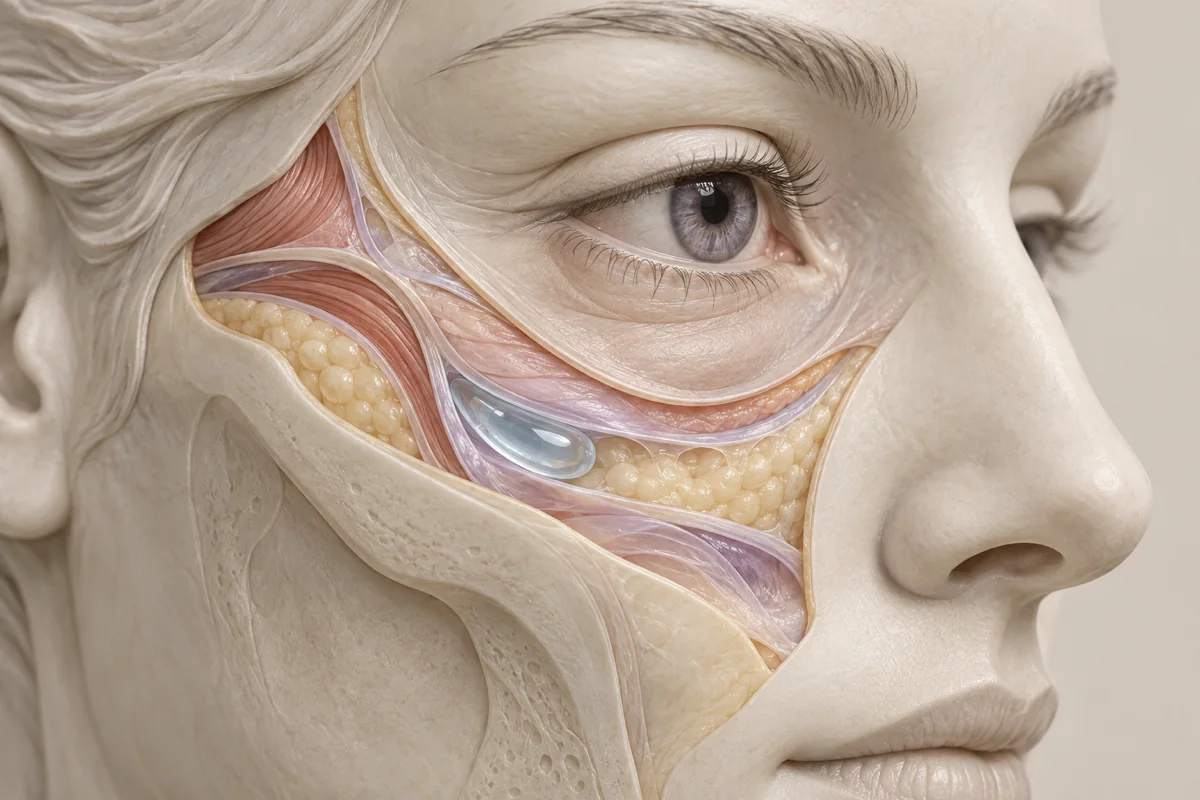
On this page
What should the assessment clarify?
Distinguish a wish for a different appearance from a possible adverse effect. Describe the product, dates, changes and symptoms. Appearance alone cannot establish remaining material or explain every change; record uncertainty openly. F1C2
| Observed change | What to describe | What remains uncertain | Why assessment matters | Question to ask |
|---|---|---|---|---|
| Perceived loss of fullness | When and how the appearance changed | Remaining material is not established by appearance | An extra injection has its own risks | What supports another procedure? F1 |
| Swelling or puffiness | Onset, persistence and associated symptoms | The cause requires assessment | More material is not an automatic solution | Should this change be investigated first? F1 |
| New lump or discomfort | Location, timing and symptom course | A delayed reaction is possible | Symptoms should be evaluated before renewal | What follow-up is needed? F1 |
These descriptions support consultation, not diagnosis or an injection schedule. FDA information describes differing materials and potentially delayed adverse effects; it supplies no universal under-eye renewal interval. F1
What are the options and limitations?
Options may include observation, further assessment or a procedure after review. Ask what another injection would address and why its expected benefit justifies its risks. You may decline. F1C1
Duration depends on material and use; no individual endpoint is guaranteed. Less visible volume does not prove complete disappearance. Swelling does not prove a top-up is needed. Neither impression is a diagnosis. F1
How should I prepare for the consultation?
Bring any product name, treatment record, dates and previous aftercare instructions. Include medications, allergies and later dental, medical or cosmetic events relevant to the history. Do not change prescribed medicines yourself. Ask for a written explanation of the proposed plan and a contact for complications. F1C2
Which risks need discussion?
Filler risks include swelling, bruising, pain, infection and nodules; some problems develop later. Accidental injection into a blood vessel can cause tissue injury, vision loss or stroke. A previous uneventful treatment does not remove the risks of another procedure. F1
How should follow-up be organised?
Document symptoms, findings and the agreed next step. An appearance change may justify review without committing to treatment. Ask what remains unknown and how to obtain reassessment for persistent or worsening symptoms. F1C2
What else should I ask?
Is there a fixed renewal date?
No universal date fits everyone. Discuss the specific material, current concern and clinical assessment rather than booking automatic refills because a stated number of months has passed. F1
Does looking less full prove the material has gone?
No. Visible appearance does not establish complete disappearance. Product history and assessment are important, especially when there has also been swelling or a delayed change. F1
Should swelling be treated with more filler?
Not automatically. Swelling is a symptom to assess, not a reliable sign of insufficient filler. Adding material without clarifying the concern introduces another procedure and its risks. F1
What if I do not know the previous product?
Request your own treatment records if available and state clearly what is unknown. Do not guess the material from a photograph; ask how uncertainty affects any further plan. F1C2
Can I choose observation instead?
Yes. Discuss observation, alternatives, limits and follow-up before consenting. Dissatisfaction does not oblige you to accept an immediate top-up or repeat-procedure package. F1C1